
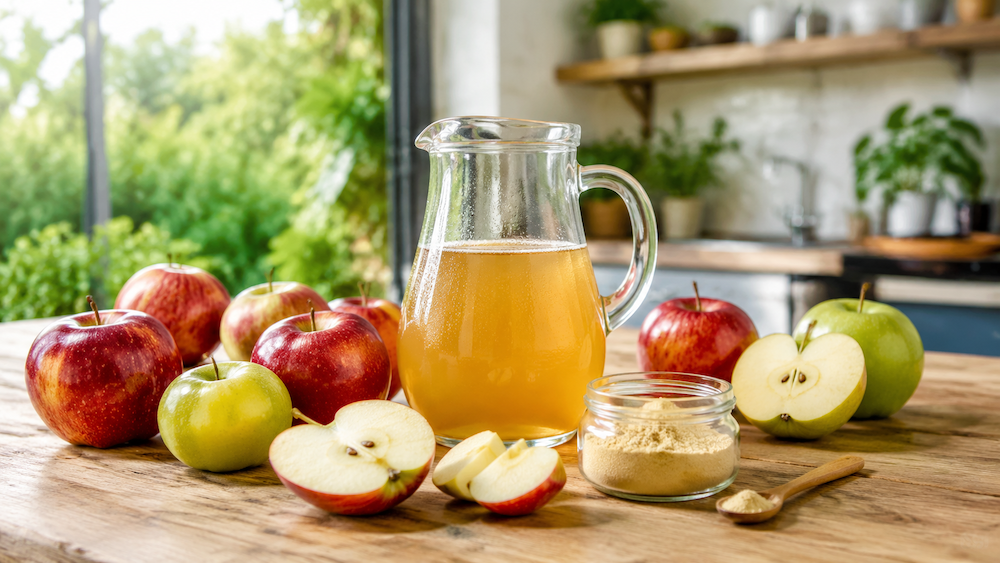
Apple juice is a natural alternative that can contribute sweetness to a variety of foods and beverages, helping reduce the amount of added sugar in formulations. For manufacturers, however, there is an even more practical way to take advantage of the fruit’s characteristics: apple powder.
Produced from apple juice, this powdered form makes it easier to incorporate the ingredient into different product matrices and expands the possibilities for developing products with a natural and clean label positioning.
The search for sugar alternatives has led research and development teams to explore new formulation possibilities. The challenge is finding ingredients that contribute to the desired sensory profile without compromising important product characteristics such as flavor, texture, and stability. In this context, fruit-based ingredients are gaining ground as valuable reformulation tools.
Apple stands out because of its mild, naturally sweet, and pleasant flavor profile, which can be used across a wide range of categories. By using the fruit in powdered form, manufacturers can incorporate it more conveniently while also adding a recognizable fruit identity to the formulation.
Why use apple to reduce sugar?
Apples contain naturally occurring sugars that contribute to their characteristic flavor. For this reason, apple-derived ingredients can help provide sweetness in formulations, allowing manufacturers to explore a partial reduction in added sugar.
It is important to note that apple powder should not simply be considered a sweetener or a direct replacement for sucrose. Its role depends on the composition and characteristics of each product. In practice, it can be used as part of a reformulation strategy, contributing simultaneously to flavor, natural appeal, and fruit identity.
This approach is especially interesting for products in which the presence of fruit already makes sense from both a sensory and positioning standpoint.
Apple powder: a practical alternative to apple juice
When considering apple as an ingredient in an industrial formulation, juice is only one of the available options. Apple powder, produced from apple juice, offers an alternative with characteristics that are particularly attractive to manufacturers, especially when it comes to storage, transportation, dosing, and ease of incorporation into products.
Instead of working with a liquid ingredient, R&D teams can incorporate the fruit in its dehydrated form directly into the formulation. This makes it easier to develop powdered products, dry mixes, and a variety of other applications where adding a liquid ingredient could interfere with the manufacturing process.
Apple powder also retains the fruit’s characteristic properties, contributing flavor while allowing manufacturers to use it as part of a formulation strategy based on natural raw materials.
Apple’s versatility makes it suitable for a wide range of applications across the food, beverage, and supplement industries. The ingredient can be used in formulations designed to add fruit flavor while contributing to the overall sweetness profile, including:
- Yogurts
- Beverages
- Smoothies
- Shakes
- Desserts
- Cereal and nutrition bars
- Baked goods
- Cookies
- Fillings
- Powdered mixes
In beverages, for example, apple powder can be combined with other fruits to create new flavor profiles. In bars, desserts, and baked goods, it can contribute the fruit’s characteristic flavor while complementing other ingredients in the formulation.
In supplements, its use can be particularly interesting in products where manufacturers want to improve the sensory profile while incorporating a fruit-derived ingredient.
What are the advantages of apple powder for manufacturers?
For research and development professionals, choosing a powdered ingredient offers advantages that go beyond flavor. Apple powder is easier to dose and incorporate into different formulations and is particularly suitable for processes where using a liquid ingredient would be less convenient.
Another advantage is the ability to use the fruit across different product categories without significantly changing the manufacturing process to accommodate a liquid ingredient. This expands the possibilities for testing and developing new products.
Apple powder can also be combined with other fruits and natural ingredients to create formulations with different sensory profiles. In this way, it can serve not only as a source of flavor but also as part of a broader product differentiation strategy.
Of course, replacing liquid apple juice with a powdered version should be evaluated individually for each formulation. Sugar performs several functions in foods beyond providing sweetness. Depending on the product, it may also affect texture, body, moisture, preservation, color, and other characteristics.
For this reason, apple powder can be used to replace part of the added sugar, rather than necessarily replacing the entire amount originally used. Bench-scale testing should evaluate different concentrations to identify the right balance between sweetness, fruit flavor, texture, and technological performance.
This approach allows R&D teams to explore a gradual reduction in added sugar while using fruit ingredients to add natural and sensory characteristics to the final product.
Frootiva’s solution for apple-based formulations
For companies looking to explore the potential of apple in industrial formulations, Frootiva offers apple powder, a practical alternative for incorporating the fruit into foods, beverages, and supplements.
Using fruit in powdered form makes it possible to explore apple’s characteristic flavor across different applications while simplifying dosing, storage, and transportation. This makes the ingredient an option for R&D teams looking to develop products with real fruit ingredients while reducing the use of ingredients intended exclusively for flavoring.
At Frootiva® Co, the process used to remove water from fruits (Spray Drying) allows the ingredient to retain the food’s properties and nutrients, including its natural flavor and color.
In addition to apple powder, Frootiva® Co’s product line also includes a wide range of fruit powders, dry extracts, vegetable powders, and soluble fiber for manufacturers looking for high-quality natural ingredients.
With ISO 9001 certification, Frootiva® reinforces its commitment to supplying ingredients that combine safety, traceability, process control, and standardization—essential factors for meeting the requirements of increasingly demanding markets.
To learn more about the products supplied by Frootiva® Co, contact us at +55 11 4765-0732 or fill out the form.
0 Comments